Key to the successful delivery of any project seeking to be regenerative for nature is the identification of explicit biodiversity objectives; it is these that form the basis of subsequent designs and decisions in the process. Objectives are likely to be contextual, and will depend on the characteristics of the site and the ambitions and priorities of the decision maker(s) and key stakeholders.
One approach to regenerative design is biodiversity sensitive urban design (BSUD, Garrard et al. 2018), which seeks to enhance on-site biodiversity. This broad objective may be reflected in more specific objectives, including:
- improving the persistence of ecologically or culturally-significant species and ecosystems, including improving connection to surrounding areas or corridors;
- bringing back or enhancing populations of target native species, including those that may have historically existed at the site, or those that represent a particular role or value; and
- enhancing or creating opportunities for nature connection and stewardship amongst the local community.
Because they form the basis for designs and outcomes of regenerative design, articulating clear objectives is important but it can also be challenging. One way to identify and articulate relevant biodiversity objectives is through stakeholder workshops. For example, when setting objectives for Fishermans Bend in Melbourne (Kirk et al. 2021), biodiversity objectives were identified during workshops that were attended by the governing body, local councils, community groups, Traditional Owners, ecologists and planning professionals. Bringing stakeholders together in this way ensured that biodiversity objectives reflected a diverse range of experiences, preferences and values and helped to ensure they were deliverable through the establishment of buy-in from key decision-makers as well as early identification of potential barriers and enablers.
The workshops resulted in a series of written statements describing how the site might be experienced by people, framing the needs of local biodiversity from the perspective of human-centric experiences of urban nature. Example human-centric objectives include:
A place where diverse native vegetation provides shade and colour: Diverse native habitat varies in structure, cooling Fishermans Bend and providing an abundance of flowers throughout the year.
A place where nature is the main thing we hear: Wildlife thrives at Fishermans Bend – birds are calling, the nights have the sounds of frogs and cicadas. Wind, rain and running water provide a background soundscape.
A place of shifting waters: As a former area of swampland, wetlands, and periodic inundation, water is a key part of Fishermans Bend. Freshwater and brackish, ephemeral and permanent, water must be an integral part of the landscape design.
When broader, human-centric objectives have been developed, a shortlist of potential, ecologically feasible target species can be created. Translating the broader objectives into more targeted fauna and flora species then helps to identify a series of clear actions, based on the ecological needs of those species, that when implemented will go on to achieve the broader objectives. The target species can be identified by the same stakeholder group or by a subset of relevant attendees with relevant local knowledge. A good target species shortlist should include species or groups that need a wide range of resource, habitat or ecosystem requirements. Target species should include locally indigenous fauna and flora and cover a wide taxonomic diversity. The specific resources needed by these species (or relevant threats to be mitigated) can then inform general and precise design guidelines for the site.
Although they are not a holistic representation of biodiversity, enhancing or bringing back focal or target species can be important biodiversity objectives. They are intuitively understood by decision-makers and community stakeholders and provide tangible touchpoints for considering key requirements and design solutions. A range of characteristics are worth considering when selecting target species, including (Mata et al. 2020):
- Ecological or conservation value of the species – will providing habitat and resources for this species benefit the species’ conservation status, or deliver benefits to other species?
- Cultural value of the species – is the species indigenous to the area? Is it of particular significance to Traditional Owners or the culture of Aboriginal people?
- Ecological feasibility – is it reasonable to expect that the requirements of the species can be provided within the urban environment?
Economic feasibility – what are the costs and benefits of bringing this species into the area? - Social acceptability – Does the species represent a specific threat or a potential opportunity for engagement?
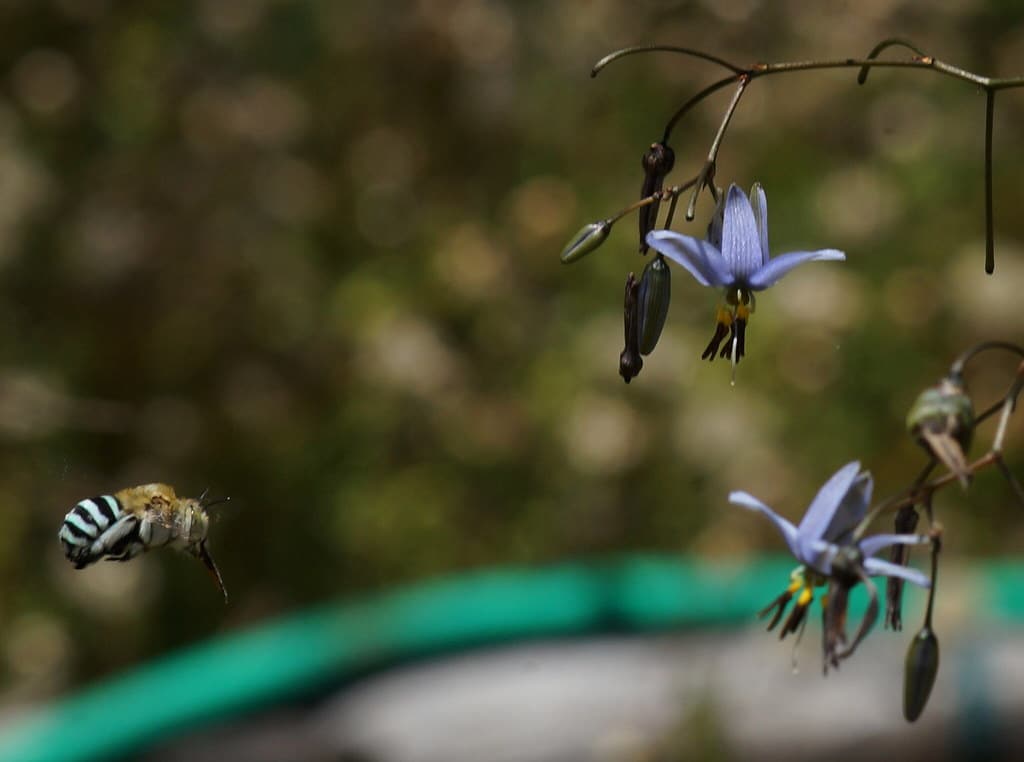
For example, in a BSUD assessment for a new development in Melbourne’s western suburbs, native blue-banded bees (Amegilla sp.) were selected as a target species. The following characteristics make this species a particularly suitable target for BSUD (Garrard et al. 2018):
- Conservation value – Blue-banded bees provide an important ecosystem service. They utilise a specific pollination method – buzz pollination – which is more effective for pollinating many native flowers. This includes flowers of the native flax-lillies in the genus Dianella, which are commonly found in native grasslands and woodlands, and whose berries are an important food source for birds and lizards.
- Social acceptability – Blue-banded bees can bridge the gap between domestic and public open space. In addition to their role in pollinating native species, blue-banded bees are effective pollinators of many domestically planted species, including amenity species such as lavender, and urban crops such as tomatoes and sweet basil. In addition, they are highly visible and easily recognisable, making them ideal for public engagement. Indeed, the significant capacity for these species to generate public enthusiasm is illustrated in the success of a recent crowdfunding campaign hosted by the Friends of the Merri Creek, which rapidly raised more than $25,000 to support the planting of ‘Bee Cafes’ – plantings of nectar-rich wildflowers in public and private spaces – to better connect populations of the endangered Matted flax-lily, Dianella amoena, in northern Melbourne.
- Ecological feasibility – Blue-banded bees will utilise novel habitats and resources. Because they will collect nectar and pollen from a wide range of native and introduced flowering plants, private gardens and ornamental public plantings can provide important habitat and resources. They are solitary nesting bees, and as such, analogue nesting habitats (e.g. mudbrick features with specially drilled holes) can be easily and successfully incorporated into urban areas.
The Atlas of Living Australia is a free resource that enables proponents to search for species that have been recorded in the vicinity of project sites, going back in time. We encourage thinking about the past, present and potential of a site, which might mean that some species are not currently recorded on the site but might be in nearby habitat patches or might have been lost from the site recently. Including both easy wins and stretch goals is a useful approach.
Setting clear biodiversity objectives for projects is an important first step for proponents seeking to be regenerative for nature. Rather than crossing our fingers or assuming that the vegetation and other habitat features we include in designs will deliver biodiversity benefits, clear objectives can help us drill down into the detail of what is required to ensure those benefits. It might be that the threats to a species persisting are equally important as resources (for example, cats outdoors preclude many birds and lizards) or that connectivity to the broader landscape is a critical element to get right. Good biodiversity objectives can help guide careful designs that are more likely to deliver good outcomes for plants and animals.
References
- Garrard GE, Williams NSG, Mata L, Thomas J, Bekessy SA. (2018) Biodiversity sensitive urban design. Conservation Letters. 11: 1-10.
- Kirk H, Garrard GE, Croeser T, Backstrom A, Berthon K, Furlong Cm, Hurley J, Thomas F, Webb A, Bekessy SA (2021) Building biodiversity into the urban fabric: A case study in applying Biodiversity Sensitive Urban Design (BSUD). Urban Forestry & Urban Greening, 62: 127176
- Mata L, Ramalho CE, Kennedy J, Parris KM, Valentine L, Miller M, Bekessy S, Hurley S, Cumpston Z (2020) Bringing nature back into cities. People and Nature, https://doi.org/10.1002/pan3.10088
Authors

Sarah Bekessy
Professor Sarah Bekessy is an Industry Laureate Fellow who leads the ICON Science research group at the University of Melbourne. ICON Science uses interdisciplinary approaches to solve complex biodiversity conservation problems. She co-developed the Biodiversity Sensitive Urban Design protocol that has now been used by numerous developers, governments and non-government organisations to design innovative urban biodiversity strategies.

Holly Kirk
Dr Holly Kirk is an urban ecologist at Curtin University, specialising in the interdisciplinary application of ecology to urban planning and design. An expert in animal movement and spatial modelling, for the last five years Holly has been using this knowledge to plan cities that support and enhance urban biodiversity. She is currently developing an open-access tool to help decision-makers prioritise places and actions for urban biodiversity conservation, funded by an ARC Industry Fellowship. Holly is passionate about translating scientific theory into positive on-ground action for people and nature.
