The nutrition label for building products, championing healthier materials to protect people and support the long-term wellbeing of our planet.

Declare is an eco-label and global database for building products that brings transparency to material selection. By distilling complex ingredient information into an easy-to-understand format, it empowers professionals, specifiers and clients to make informed choices for healthier buildings.
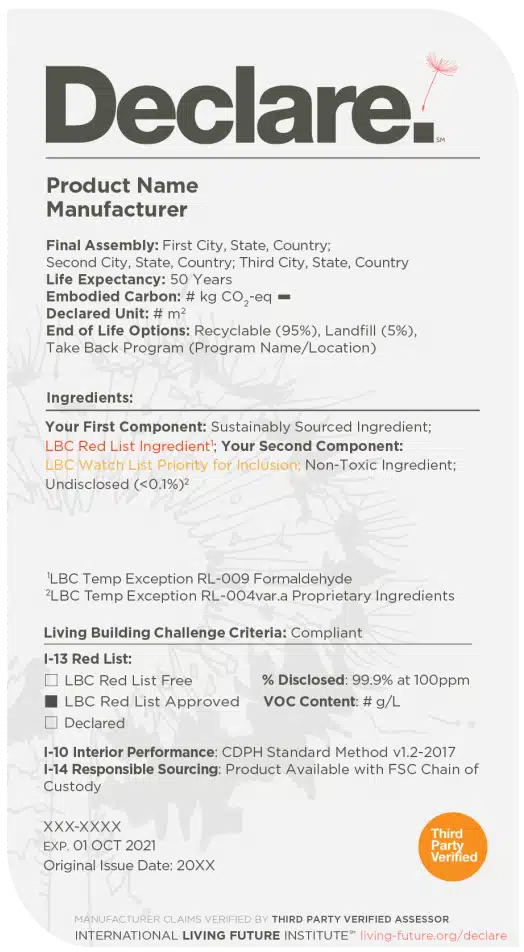
Life expectancy and end of life options: How long will this product last and what can you do with it when you’re finished with it?
Final assembly location: Where was the product made?
Chemical ingredients: What is in this product?
Embodied Carbon (Optional): What is the global warming potential of the product, based on a compliant environmental product declaration (EPD)?
Red List compliance: Are there Red List ingredients in this product?
Percentage Disclosed: What percentage of ingredients >0.01% of the final product, have been disclosed? (min. required 99%)
VOC info: Does this product contain Volatile Organic Compounds, and if so is it within acceptable limits to prevent off-gassing? For liquid products, how many g/L VOCs are contained? (VOC content)
Third Party Verified (optional extra step): Manufacturer’s label information has been independently assessed.
The label answers three essential questions:

Where does the product come from?

What is it made of?

Where does it go at the end of its life?
Declare labels disclose at least 99% of a product’s ingredients, alongside key information such as responsible sourcing, VOC content and embodied carbon. Products that achieve Red List Free status go a step further, confirming they contain none of the industry’s “worst-in-class” chemicals.
As the built environment moves towards regenerative design and circular principles, materials health and transparency is becoming increasingly vital. Programs like Declare build shared knowledge, shift supply chains, and enable the industry to make better decisions to support a built environment that is healthier for both people and the planet.
Why Declare?
Consumer Trust
Declare provides proof that your product is one that can be trusted. Rise above greenwash and connect with consumers who value transparency and genuine sustainability.
Competitive Advantage
Demonstrate market leadership in the healthy materials movement, which has grown to more than 400 manufacturers globally—from start-ups to legacy brands.
Market Access
Gain expanded market access to the world’s greenest buildings and groundbreaking regenerative projects through a direct connection to the Living Building Challenge, Green Star, LEED, and WELL Certifications.

Manufacturer Resources
Looking to get a Declare label for your product? Find helpful context to the program, the Red List and more in the resources below:

FAQ
How long does it take to get a Declare label?
Timeframes depend on the complexity of your product and the accuracy of the information provided. As a guide, allow 4–6 weeks from initial enquiry to publication.
Contact us to discuss your product:
[email protected] or [email protected]
How long does a Declare label last for?
A Declare label is valid for one year and can be renewed up to two months prior to expiry to maintain its listing.
We contact manufacturers ahead of expiry to confirm whether any changes have been made to product ingredients or formulation.
Can I apply for a Declare label if my product contains Red List chemicals?
Yes! Declare is grounded in transparency and supports informed decision-making.
Products containing Red List chemicals can still achieve a label, with these substances clearly disclosed in red text on both the label and database entry. Chemicals on the Priority for Red List are shown in orange text on the label.
We encourage manufacturers to advocate for healthier alternatives and work towards eliminating harmful chemicals from their products and supply chains.
For Living Building Challenge projects, at least 90% of materials must be Red List Free.
How does a chemical get added to the Red List?
The Living Building Challenge Red List identifies “worst-in-class” chemicals commonly used in the building industry that pose risks to human and environmental health. It is reviewed annually with input from global materials experts.
Supporting lists—the Watch List and Priority List—provide a transparent pathway for future inclusion. Chemicals must remain on the Priority List for at least 12 months before being added to the Red List, allowing time for safer alternatives to be developed.
How can Declare contribute to Green Star Buildings through the Responsible Products Program?
Declare labels are recognised in the Green Building Council of Australia’s (GBCA) Responsible Products Framework and are assigned a Responsible Product Value (RPV. For example, Declared labels achieve RPV 4, whereas Red List Free or Red List Approved Declare labels achieve RPV 8.
Combine Declare with other initiatives to go further. For example, pairing a Declare RLF or RLA label with FSC COC or product-specific EPD can achieve: Best Practice across all categories (requires min. RPV 11–15).
Are healthy materials and the Declare database only relevant to Living Building Challenge project teams?
Healthy materials and product transparency are relevant across the entire building industry.
By improving what goes into our buildings, we can create spaces that leave a positive legacy on the health of all living beings and the planet.
How can I as a specifier make a big impact on the healthy materials revolution?
Make informed decisions by understanding what eco-labels reveal about a product—from its impacts on human health to its circularity, longevity, responsible sourcing, and global warming potential. Declare supports this process by providing clear, accessible insights into these critical aspects of material and environmental health, helping you select products with confidence.
If I achieve a Declare label for my product do I need to put an actual physical label on the product?
Declare labels are published on the free public database. There is no requirement to apply a physical label to products.
However, some manufacturers choose to display the Declare or Red List Free mark on packaging, products, or websites to communicate their achievement.
Are there labs in Oceania that can do the approved emissions testing?
Yes. In Australia, laboratories such as BELL Laboratories and CETEC conduct approved emissions testing in line with the California Department of Public Health (CDPH) Standard Method or equivalent.
The Declare label indicates compliance with the Living Building Challenge Healthy Interior Performance requirements. Products for installation within the building envelope (the interior of the wall and roof vapour barrier) that may emit Volatile Organic Compounds (VOCs) must provide certification against an approved emissions standard.
Refer to the Declare Manufacturer’s Guide for full requirements.
Industry specifiers are asking for embodied carbon data, does a Declare Label include this information?
Yes, embodied carbon disclosure is optional within Declare.
Refer to the section on embodied carbon in the Declare Manufacturer’s Guide for current requirements.
See these listings for product examples of how embodied carbon is displayed in Declare (products registered in Australia and Aotearoa New Zealand).
What’s the difference between a Declare Label and the Living Product Challenge?
Declare provides transparency on where a product comes from, what it is made of, and where it goes at end of life. It may also include VOC compliance, responsible sourcing, and optional third-party verification and embodied carbon data.
The Living Product Challenge (LPC) builds on this foundation, assessing products across seven performance areas, including carbon, water, energy, and waste. A third-party verified Declare label is the first step towards LPC.
The Declare Summary and LPC Summary and LPC standard are available for further reference.
We’d love to have LPC products registered in Australia and Aotearoa New Zealand, so if you’re a manufacturer that’s up for the challenge, reach out to us to find out more.